

This explainer video guide for 2026 is a practical, end-to-end resource for anyone looking to understand, plan, create, and scale high-impact explainer videos.
It brings together proven storytelling principles, real-world production insights, performance-driven strategies, and industry best practices to help build explainer videos that deliver real impact.
At What A Story, we’ve been creating explainer videos for the last 10+ years across industries such as AI, SaaS, fintech, healthcare, and eCommerce, working with clients from around the world.
After producing over 1,200+ explainer videos, this guide reflects the learnings and patterns we’ve seen consistently work.
Why We Wrote This Guide
We’re sharing the exact internal frameworks we use at What A Story to move prospects from "confused" to "converted" in under 60-90 seconds.
- 10+ Years of industry-leading production experience.
- 1,200+ Videos delivered to global brands.
- 50+ AI & SaaS Clients helped to simplify complex tech.
What is an Explainer Video?
A short, focused video designed to clearly explain a product, service, concept, or process in a simple and engaging way is called an explainer video. It is an essential marketing and educational tool that businesses use to give their viewers clarity and inspire actions with confidence.
One can say that they evolved from powerpoint and the explosion of youtube as a video platform. These videos combine customised graphics, voiceover, kinetic text and motion design to present complex ideas in a dynamic manner to capture the attention of an audience.
They are used to introduce new products, explain features, onboard users, communicate value propositions or simplify technical topics.
Generally around 60-90 seconds, most explainer videos follow a structured narrative - starting with a problem, introducing a solution, showing how it works and ending with a clear call to action.
And depending upon how the brand wants to speak to the audience they can have a professional, authoritative, conversational or a casual everyday tone.
The What A Story Reality Check: - Most brands think an explainer video is a summary of their product. It’s not. In 2026, an effective explainer is a bridge. It’s the shortest distance between a customer’s current frustration and your solution’s "Aha!" moment. If you try to explain every feature, you explain nothing.
Why Explainer Videos Matter in 2026
In the last few years platforms have doubled down on video content. Audiences demand clarity in less time and businesses want to make informed decisions amidst the chaos of competitive pitches.
And with the rise of AI that is making production of video content faster and affordable every decision maker is super fatigued and saturated with information.
We are drowning in information but starving for meaning!
This is where explainer videos become an essential part of your marketing infrastructure. They now have to be created with the intention of putting forth a clear narrative that can stand apart from all the noise and communicate value to help your clients discover, evaluate and decide to opt for your product or service.
And explainer video is now one of the most efficient formats for simplifying complex ideas and accelerating understanding in crowded digital environments.
In 2026, explainer videos with authentic storytelling, emotional framing and clarity of brand voice will drive higher watch time, faster onboarding, stronger retention and significantly better conversion outcomes than all generic marketing content.
Use of Explainer Video in Modern Video Marketing
As the most widely used and effective formats in modern video marketing explainer videos dominate digital channels.
Industry data shows that 91% of businesses now use video as a marketing tool, and explainer videos are the second largest kind of videos used by businesses.
In the last few years it has been reported that around 73% of users have brought a product after watching an explainer video about it.
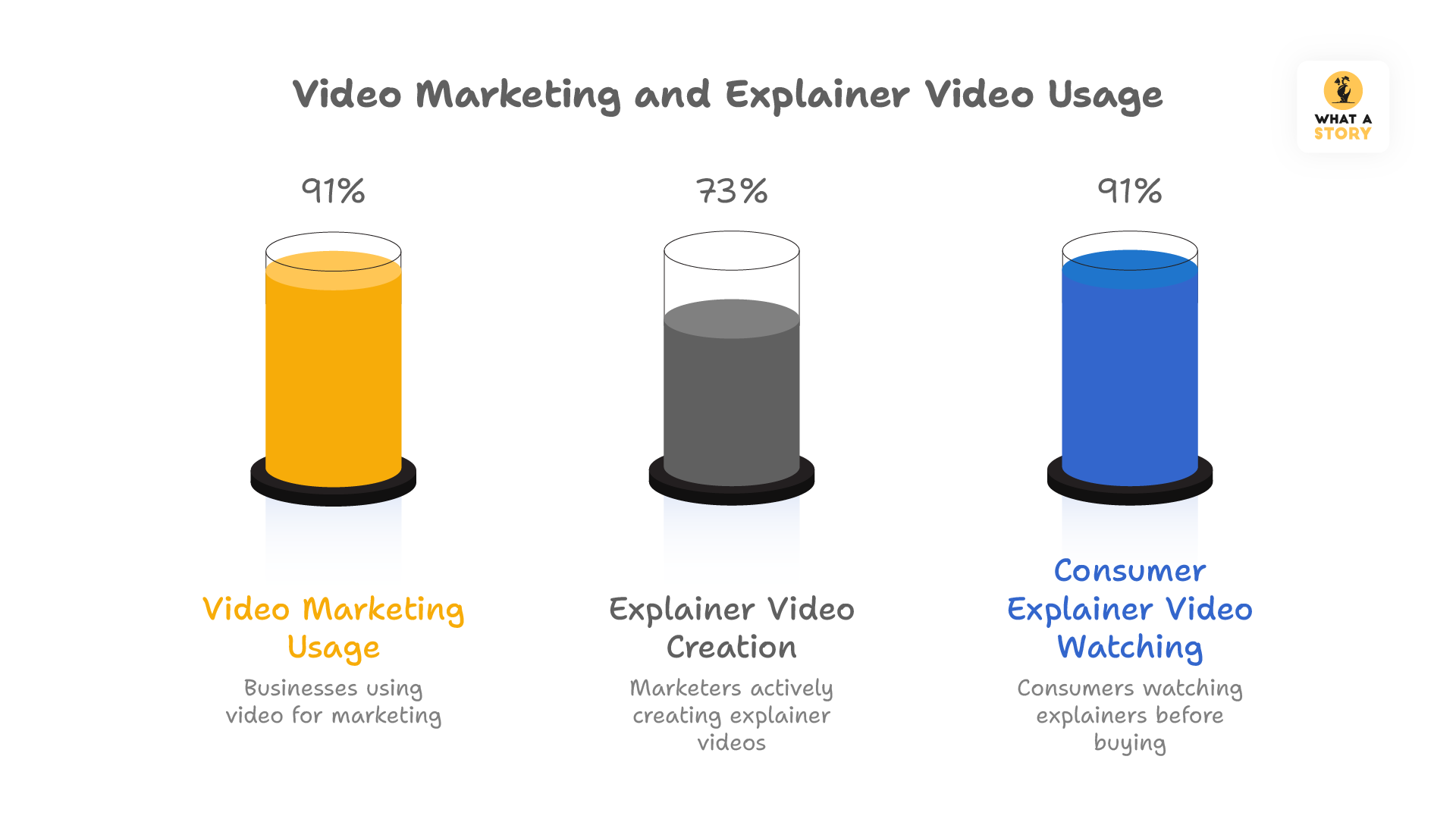
The 2026 video marketing strategy should use explainer video to:
- Improve landing page conversions.
- Build product credibility and trust amongst decision makers.
- Spread a wide net for lead generation across various digital campaigns.
- Reduce sales cycles, improve onboarding experience and retention rate.
- Strengthen brand awareness and trust across social media.
- Enhance SEO rankings
Explainer videos are not a “nice to have” marketing asset anymore; they are now the most critical part of success of a marketing strategy.
Explainer Video Fundamentals
Key characteristics of an explainer video
An explainer video like any effective storytelling and marketing tool works on several levels and has layers that make it a perfect recipe for your audience. The various key characteristics of an explainer video are:
- A Concise Structure: an explainer video will have a clearly defined problem, a strong introduction of the solution, a quick demo of how it works and a targeted call to action.
- Focused on Target Audience: The language, tone and pain points presented in an explainer video all cater to a specific audience set.
- High Quality Visuals, Sound and Motion Design: With customised motion, live action, mix-media, UI animation, voiceover and sfx an explainer makes for a rich visual asset.
- Optimal Length: Between 60-90 seconds an explainer video maintains viewer engagement in an effective and impactful manner.
How explainer videos work?
An explainer video combines storytelling, clear structure, and visual cues that come together to simplify complex ideas and improve understanding of the viewer that helps them take action with trust.
A good explainer video will connect with an audience on both logical as well as an emotional level.
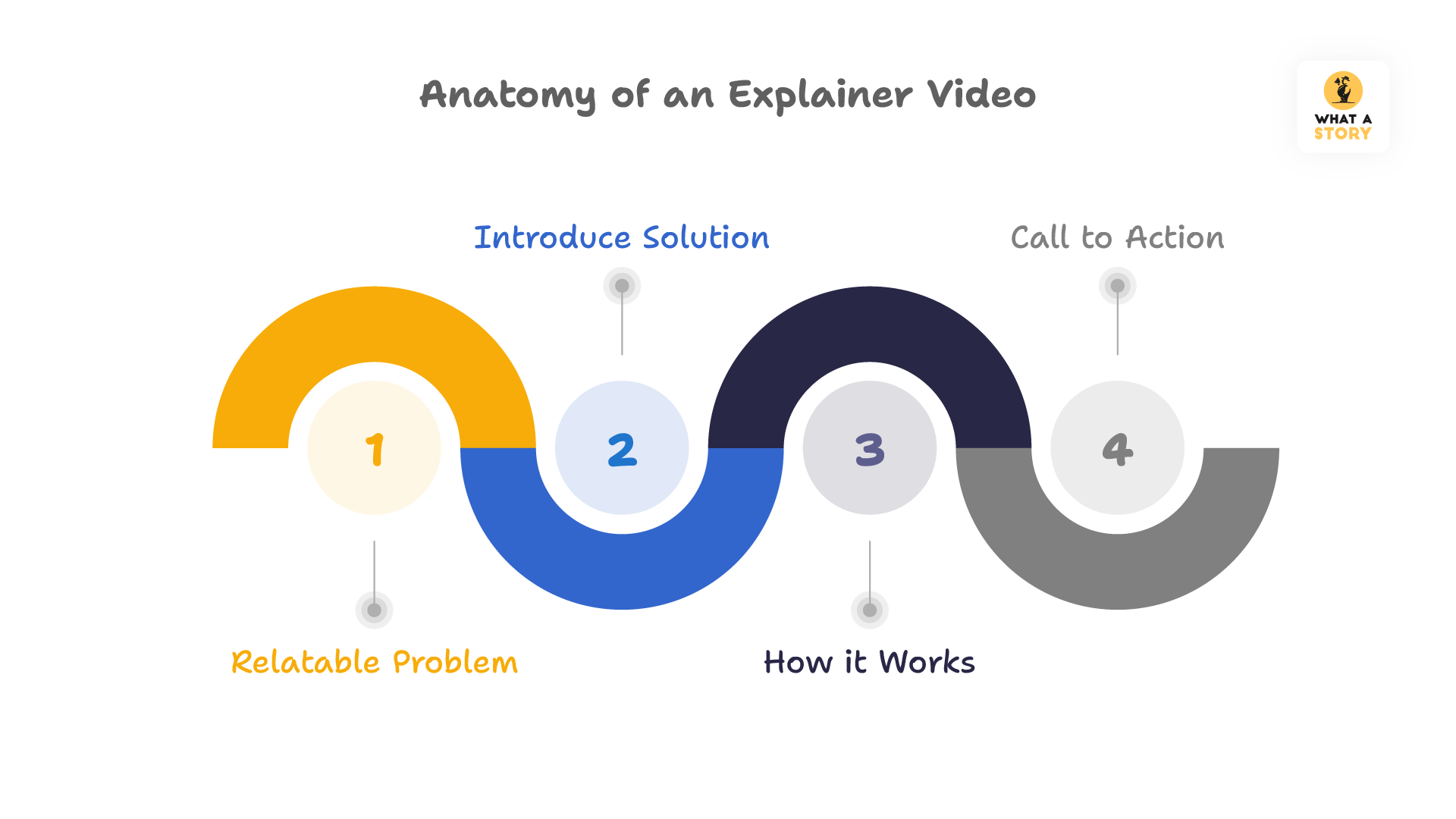
It all starts with a relatable problem, need, desire or aspiration that helps the viewer hook onto the video. Then in the context of that hook the video introduces the solution.
As the audience is now brought into this world the video then takes them to the “how it works” section that helps the audience envision the possibilities of the product in their lives. And once they have fully bought into it comes the call to action.
It sounds simple and it is, the magic of a good explainer video lies in the sum of its parts.
Pro-Tip: The 8-Second Rule - After analyzing 1,200+ projects, we’ve found that the first 8 seconds are the most critical. If you don't hook the viewer by validating their specific pain point immediately, drop-off rates increase by nearly 40%.
Common Uses of Explainer Video
Explainer videos are widely used across marketing, sales, education, and customer success. They common uses of explainer videos are :
- Product or Service Introduction: SaaS companies often use an explainer video on their homepage to introduce their product and drive landing page conversion.
- Simplifying Complex or Technical Concepts: Complicated ideas, processes or technologies such as fintech solutions can be explained with easy to understand visuals and use cases.
- Sales Enablement and Pitch Support: B2B companies often share an explainer video with prospects before a demo call or with follow up emails.
- Customer Onboarding and Training: Guides new users on how to get started and understand key features or workflows to ensure smooth onboarding and improved retention.
- Customer Support and FAQs: Reduces support tickets by answering common questions through video that address things such as billing or set up queries.
Explainer vs Product Demo Video vs Brand Video vs Walkthrough Video
Explainer Video Strategy and Planning (Before You Create)
Proper Strategy and planning is imperative to make your explainer videos achieve the desired impact. Before scripting or designing visuals, it is essential to define goals, audience, messaging and the right explainer format.
These will make for a strong video brief that you can pass onto your video teams to ensure everyone is on the same page.

Explainer video strategy
An effective explainer video strategy aligns with where the viewer is in the customer journey.
- At The Awareness stage: Explainer videos at this stage focus on big picture value and simple storytelling.The goal is to introduce a problem, spark interest, build initial understanding that is best for social media, homepage hero sections, and brand discovery campaigns.
- At The Consideration Stage: Explainers highlight product benefits, use cases and how the solution solves real problems. This helps prospects evaluate solutions and understand differentiation. Best for product pages, email nurturing, and sales enablement.
- At The Conversion Stage: Explainers focus on clarity, proof and removing objections. Best for landing pages, pricing pages and retargeting campaigns. The goal is to drive action such as sign ups, demos, or purchases.
Audience and buyer persona mapping
A high impact explainer video is built around a clearly defined audience.
Key questions to map before creation:
- Who is the primary viewer
- What problem are they trying to solve
- What level of knowledge do they already have
- What motivates their decision making
- What objections or concerns might they have
For example - an explainer targeting technical decision makers may focus on functionality and integration, while one targeting business leaders may emphasize ROI and efficiency. Matching tone, depth and messaging to the persona significantly increases the impact of the explainer video.
Messaging framework for high impact explainer videos
Successful explainer videos follow a structured messaging framework designed to maximize clarity and persuasion.
The key principle here is focus. One explainer should deliver one core message rather than multiple competing ideas.
A common high impact framework includes:
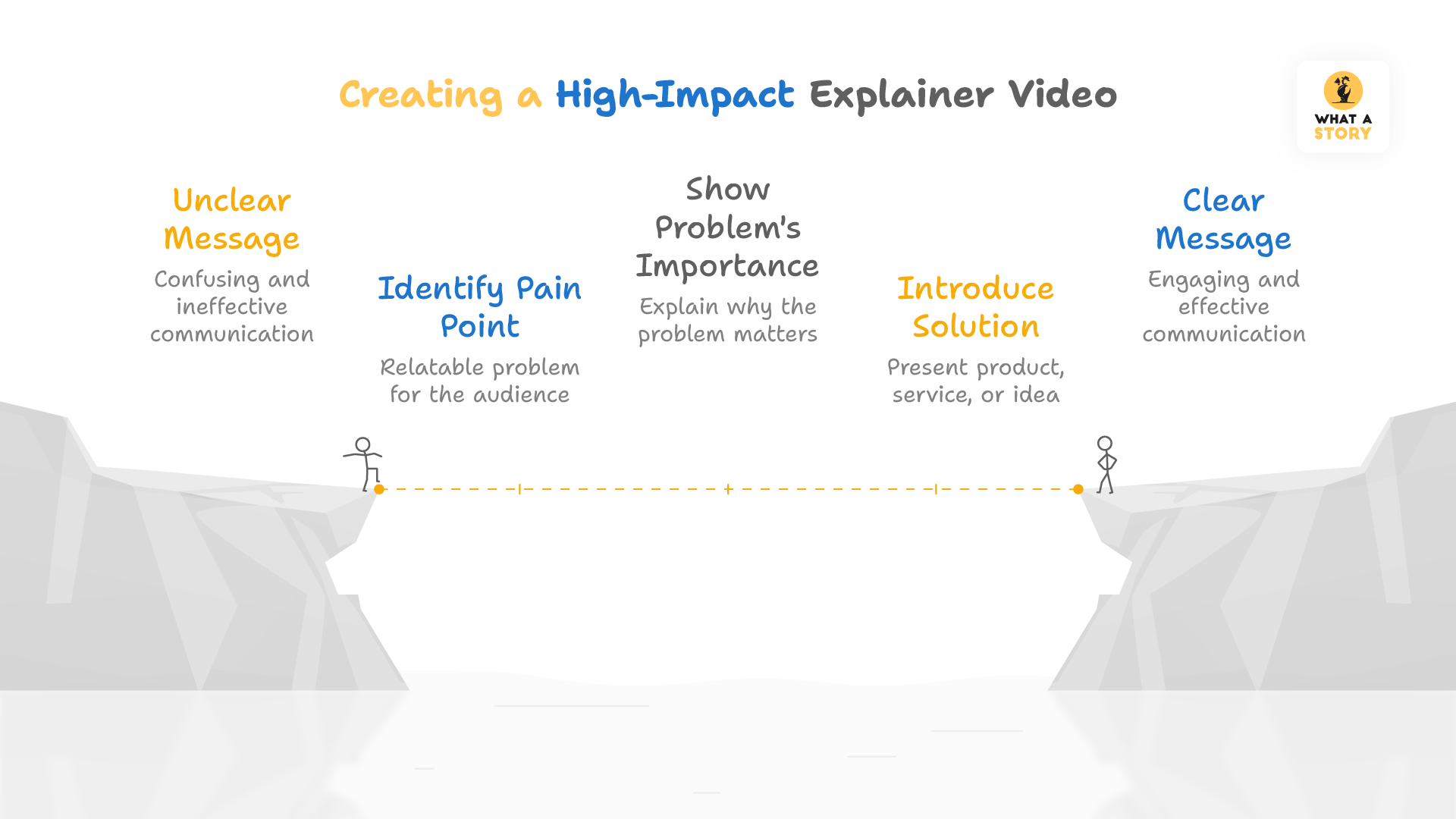
- Problem: Identify a relatable pain point
- Insight: Show why the problem matters
- Solution: Introduce the product, service, or idea
- How it works: Explain simply and visually
- Benefits: Highlight outcomes and value
- Proof: Add credibility through results or examples
- Call to action: Tell viewers what to do next
What kind of explainer videos work best for your brand?
Rather than following trends the choice of the right explainer format depends on brand identity, audience and business goals. The most effective brands choose explainer formats that align with their tone, budget, audience expectations and distribution channels.
For example:
- Animated explainer videos are best for simplifying abstract or technical concepts and demonstrating how the UI of the product works.
- Live action explainer videos are best for human connection and thought leadership by the founders.
- Whiteboard or educational explainer videos are work for training and educational material.
Read Also: Types of SaaS Videos for Every Funnel Stage
Benefits of an Explainer Video
As discussed earlier explainer videos deliver measurable impact across marketing, sales and customer education.
The following are the primary benefits of an explainer video:
1. Higher engagement & retention
Explainer videos combine the power of seamless animation and a fluid narrative that helps users easily understand the way the product works and drives them towards signing-up.
This explainer video we created for Fronter helped simplify the way the platform works and contributed to rapid user adoption by making the product instantly understandable.
2. Improved conversion rates
Landing pages with explainer videos often report higher conversion rates because videos reduce friction and build confidence by answering key questions of all stakeholders.
For example take a look at this explainer video we created for a fintech product that helped demonstrate its accounting efficiency on the landing page and appeal to different stakeholders instantly.
3. Faster buyer understanding of complex products
Explainer videos reduce cognitive load and large amounts of time spent by buyers in research by translating technical features into relevant benefits and outcomes.
Look at how we used everyday examples in this explainer video for a wealth management platform to help non technical buyers quickly grasp product value without needing demos or sales calls.
4. Scalable education across teams and customers
One explainer video can serve marketing, sales, onboarding and support simultaneously, reducing repetitive human effort.
Take a look at this explainer video of a monitoring tool that helps achieve address queries across all functions and serves as a tool at different stages.
Case Study of One of Our Clients: - ZELIQ Raises a $15M+ Series A, Using a What a Story Explainer Video
Role of Explainer Videos Across the Funnel
Explainers drive impact from awareness to conversion and play a different but complementary role at every stage of the customer journey.
How Explainer Videos Reduce Sales Cycle Time
Explainer videos shorten sales cycles with their clarity, by educating prospects thoroughly and minimizing repetitive explanations by sales teams.
Educating buyers before sales calls
B2B companies often send animated explainer videos before discovery calls to enable more qualified conversations and shorter deal cycles.
Explainers give prospects foundational understanding before interacting with sales, allowing conversations to focus on decision making instead of basic education.
Reducing back and forth communication
A single explainer video can answer common objections around pricing, features, integrations and ROI.
This reduces the number of follow up emails and meetings required to move a deal forward. Sales teams use explainer videos in email nurturing sequences that shorten time from lead to demo booking.
Increasing decision maker alignment
Explainer videos can be shared internally by prospects with finance, leadership, or technical teams and help align stakeholders faster.
They come in handy with enterprise software companies that use explainers to help internal champions sell the solution inside their organization, thereby accelerating approvals.
Improving lead quality and filtering
Explainers attract relevant prospects who already understand value and fit and reduce time wasted on low intent leads.
This ensures that your sales teams spend more time closing and less time educating.
Scaling sales without increasing headcount
Explainer videos allow one sales message to reach thousands of prospects consistently, reducing dependency on one to one demos in early stages.
At the growth stage SaaS companies often pair explainer videos with self-serve demos to close deals faster and at lower acquisition cost.
Give a Read to This: Video Marketing Funnel Strategy
Explainer Video Types & Styles
What are the best styles of explainer videos for B2B SaaS products?
Explainer videos come in multiple formats, each suited for different goals, audiences and industries. Choosing the right type depends on what you want to explain, who you are targeting and where the video will be used.
Each type offers unique strengths, but the most effective explainer videos prioritize clarity, relevance and audience fit over style alone.
1. Motion Graphics & 2D Animation (Top-of-Funnel)
This remains the industry standard for brand awareness. It uses abstract visuals and slick transitions to explain complex, data-driven concepts without overwhelming the viewer with technical UI.
- Best for: Cybersecurity, AI infrastructure, and analytics platforms.
- Why it works: It focuses on the "vision" and problem/solution narrative rather than specific clicks.
2. Screencast & UI Animation (Middle-to-Bottom Funnel
This style focuses on "Product-Led Growth" by showing the actual software interface. Modern versions often use "Figma-style" animations where the UI is simplified or stylized to look cleaner than the real product.
- Best for: Productivity tools (like Slack or Monday.com) and CRM platforms.
- Why it works: It builds "buyer intent" by proving the software is intuitive and easy to use.
3. Mixed Media: Live Action + UI Overlays
This style combines footage of a person (often a founder or a relatable "customer") with digital UI elements floating on screen. This format is increasingly popular on platforms like LinkedIn and X (formerly Twitter).
- Best for: Humanizing a brand and building trust.
- Why it works: It adds a face to the company while simultaneously demonstrating the product's capabilities, leading to higher credibility.
4. Minimalist 3D Animation
High-end SaaS companies use 3D to visualize "invisible systems" like cloud storage or global networking. It gives the product a premium, enterprise-ready feel.
- Best for: Enterprise-level SaaS and hardware-software integrations (e.g., IoT).
5. Kinetic typography / text-first micro videos
- Why it works: optimized for social feeds and sound-off environments (LinkedIn, X/Twitter, Instagram). Fast and low-cost to make at scale.
- When to use: short social ads, announcement posts, or lead-gen creative.
- Typical length: 15–30s for reels/shorts; up to 60s for LinkedIn ads.
Explainer video types by industry with examples
SaaS: Used to explain software platforms, workflows and product value quickly.
Fintech: Used to simplify complex financial concepts such as digital payments, investments, or blockchain.
Healthcare: Used to educate patients, explain medical services or guide care processes.
EdTech: Used to teach concepts, onboard students and explain learning platforms.
Explainer Video Production Process
A structured production process ensures explainer videos are not just visually engaging, but also strategically aligned to business outcomes.
The 7 Step Explainer Video Production Process Includes
i. Creative Discovery, Deep Dive & A Strong Creative Brief: - This ensures a detailed creative brief is created so that everyone working on the project is aligned with goals and expectations.
ii. Script Writing: - A compelling narrative is developed that focuses on the customer problem, product solution, and core benefits.
iii. Storyboarding: - Storyboards define scene-by-scene visuals, transitions and framing.
iv. Illustration & Visual Design: - At this stage custom illustrations, characters, UI elements and brand assets are designed.
v. Animation / Video Production: - Motion design, timing, transitions and visual effects are crafted to enhance storytelling and maintain viewer engagement.
vi. Voiceover, Sound Design & Music: - Professional voiceover is recorded, along with background music and sound effects. Audio elements that enhance emotional impact, pacing and overall production quality are added to create further layers of storytelling in the video. .
vii. Final Editing, Review & Delivery: - The video undergoes feedback rounds, refinements and optimization for multiple platforms such as websites, ads, social media, and sales decks. And is now ready to go into
You can check the detailed video production process along with examples for each stage here.
Explainer Video Cost in 2026
Explainer video costs vary based on complexity, length, animation style, customization level and production quality. Typical SaaS explainer video pricing ranges from entry-level budget productions to premium studio-grade videos depending on scope.
Key cost drivers that impact the video pricing include things like video length, animation styles, filmmaking treatments, complexity of illustrations and the skill proficiency of the team working on it.
Generally, the more the customization and cinematic quality the higher the production cost.
Check out this page to get the estimation of an explainer video here
How Long Does It Take to Make an Explainer Video?
On average, a high-quality SaaS explainer video takes 4 to 8 weeks from discovery to final delivery. Faster timelines are possible but may require additional budget or reduced scope.
Timelines largely depend on script approval speed, feedback cycles, production complexity and responsiveness of the approval team to keep moving the production forward.
Distribution, SEO and Visibility
Explainer videos create the most impact when they are distributed strategically across high intent and high traffic channels. The right placement improves reach, engagement, conversions and search visibility.
Where to use explainer videos
You can get the most out of your explainer videos by placing them at:
Performance, Analytics and ROI
Explainer videos are measurable performance tools that impact engagement, conversions, lead quality and revenue. When tracked correctly, they provide clear ROI across marketing, sales, and customer success.
Explainer video metrics & KPIs
To evaluate effectiveness, performance should be tracked across awareness, engagement and conversion stages.
Choosing the Right Explainer Video Partner
Selecting the right explainer video production company can significantly impact the quality, performance and ROI of your video.
The ideal partner is a strategic collaborator who understands your business goals, audience, messaging and can translate them into a high impact visual story .
A strong agency should combine creative storytelling, proven production processes, transparent pricing and industry relevant experience.
Steps to choose the right explainer video production company
For choosing the right agency you have to make sure that your goals and expectations are defined. This allows you to formulate an apt creative brief and shortlist agencies with relevant experience.
Once you do that you can evaluate their portfolio, storytelling approach, assess service capabilities, validate them through testimonials. And before onboarding you can compare pricing and see if they fit into your practices as a collaborator.
You can check a detailed post we wrote to help you evaluate the right video production agency here.
Trends, AI and the Future of Explainer Videos
Explainer videos are evolving rapidly as AI, personalization, automation and changing viewer behavior reshape how videos are created, distributed and consumed. The future of explainer videos will be defined by faster production, smarter targeting and deeper audience engagement.
AI in explainer video creation
AI is transforming explainer video production by reducing time, cost and manual effort across scripting, design, animation, voiceover and editing.
Key AI driven capabilities include:
- AI assisted script generation and optimization
- Automated storyboarding and scene planning
- Text to animation and text to video creation
- AI voiceovers and multilingual dubbing
- Faster video localization and versioning
- Automated captioning, subtitling, and formatting for platforms
Human vs AI generated explainer videos
AI generated explainer videos offer speed, cost efficiency and scalability, but human led production still excels in storytelling depth, emotional nuance and strategic thinking.
The future will likely be hybrid. AI will handle speed and scale while humans focus on strategy, creativity, narrative and emotional impact.
While AI helps us speed up technical workflows, our "Human-First" protocol ensures your brand doesn't sound like a machine. We use AI for efficiency but rely on human directors to craft the strategic soul and emotional nuance that actually builds trust. AI can generate frames; only humans can generate "feelings."
Common Mistakes and Best Practices
The most common pattern of mistakes when creating an explainer video involves things like trying to explain too much in one video, starting too slow and failing to hook the viewers.
Not optimising for platforms, and having a generic message instead of one where you are focused on an audience persona. This results in a weak video that fails to deliver the desired business outcomes.
Real impactful explainer videos are made when the best practices come together across all layers. When there is complete focus on one core problem and solution, a strong hook, and a concise message under 120 seconds.
With a simple and easy to understand narrative designed for the target audience, optimising for viewer behavior, and driving a clear call to action.

Conclusion
Explainer videos remain one of the most powerful tools for simplifying ideas, educating audiences and driving conversions.
As AI accelerates production and personalization reshapes viewer expectations, the most successful explainer videos will combine strategic storytelling, strong messaging, data driven optimization and creative clarity.
Brands that treat explainer videos as long term performance assets rather than one time creative projects will gain a lasting advantage in marketing, sales, onboarding and customer communication.


